If you run DB2, the last two posts in this series may have felt like someone else's problem. MySQL 8.0 reached end of community support in April. SQL Server 2016 leaves extended support on July 14. Both posts were really about a deadline.
DB2's isn't here yet. IBM supports Db2 LUW 11.5 until April 30, 2027, and hasn't published an end-of-support date for 12.1 at all. So there's no forced migration this summer and no version going dark this quarter — but there is a date, and it's nearer than most Db2 estates are planning for. Two others are already behind you: 11.1's extended support ran out on April 30, 2026, and Db2 Base Edition 11.5.x left standard support on September 30, 2025, with its sustained support ending on September 30, 2026.
So this post is the counter-narrative. Not "your version is dying this month," but "you have runway, and your monitoring should finally catch up to your database before you spend it."
Because the gap with DB2 was never really about the version. It's that the tooling has lagged what the database can actually tell you. The DB2 Plug-in for Oracle Enterprise Manager, entering Early Access on July 31, 2026, is built to close that gap, and it's the first Oracle EM plug-in heading toward two places nothing else covers.
This post has three parts: why DB2 is a continuity story, what the plug-in closes that even IBM's own free console doesn't, and the new ground on the roadmap.
1. The continuity story
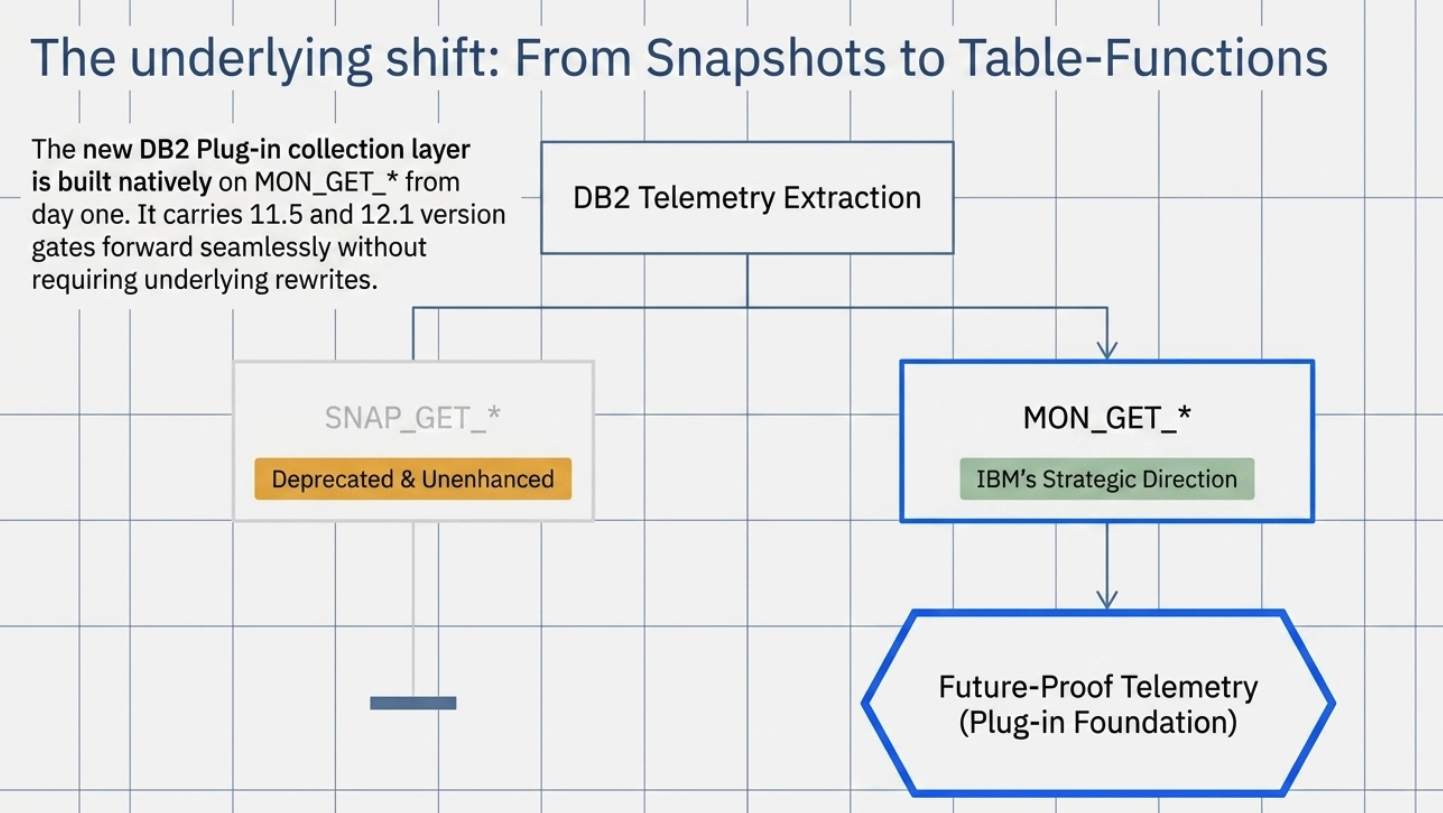
DB2's monitoring foundation is in good shape, and that's the point. Db2 11.5 and 12.1 both expose the modern MON_GET_* table-function interface, which IBM has made the strategic direction for monitoring while the old SNAP_GET_* snapshot functions sit deprecated and unenhanced. So there's no interface churn to absorb the way MySQL 8.4 forces on the replication side. The plug-in's collection layer is built on MON_GET_* from the start and carries the 11.5 and 12.1 version gates forward without a rewrite.
That's worth saying plainly, because it changes the buying posture. There is a clock, but you aren't racing it: April 2027 is far enough out to do this deliberately, and close enough that waiting has a price. You're choosing, on your own schedule, to see more of a database you'll still be running long after the 11.5 upgrade is behind you.
The version matrix carries both releases forward, and a compliance rule takes the lifecycle question off your calendar. It reads each target's release from the configuration snapshot, compares it against IBM's published end-of-support dates, and raises a critical violation once that date is in the past. It's date-driven rather than a hardcoded list of bad versions, so it begins flagging your 11.5 estate by itself on May 1, 2027 — no plug-in update, no threshold edit, no reminder for someone to keep. Releases IBM hasn't dated, 12.1 among them, map to nothing and can't raise a false violation. So the one genuine lifecycle risk, an instance stranded on a dead release, becomes a screen instead of a surprise.
2. What the plug-in closes, including gaps IBM's own console leaves open
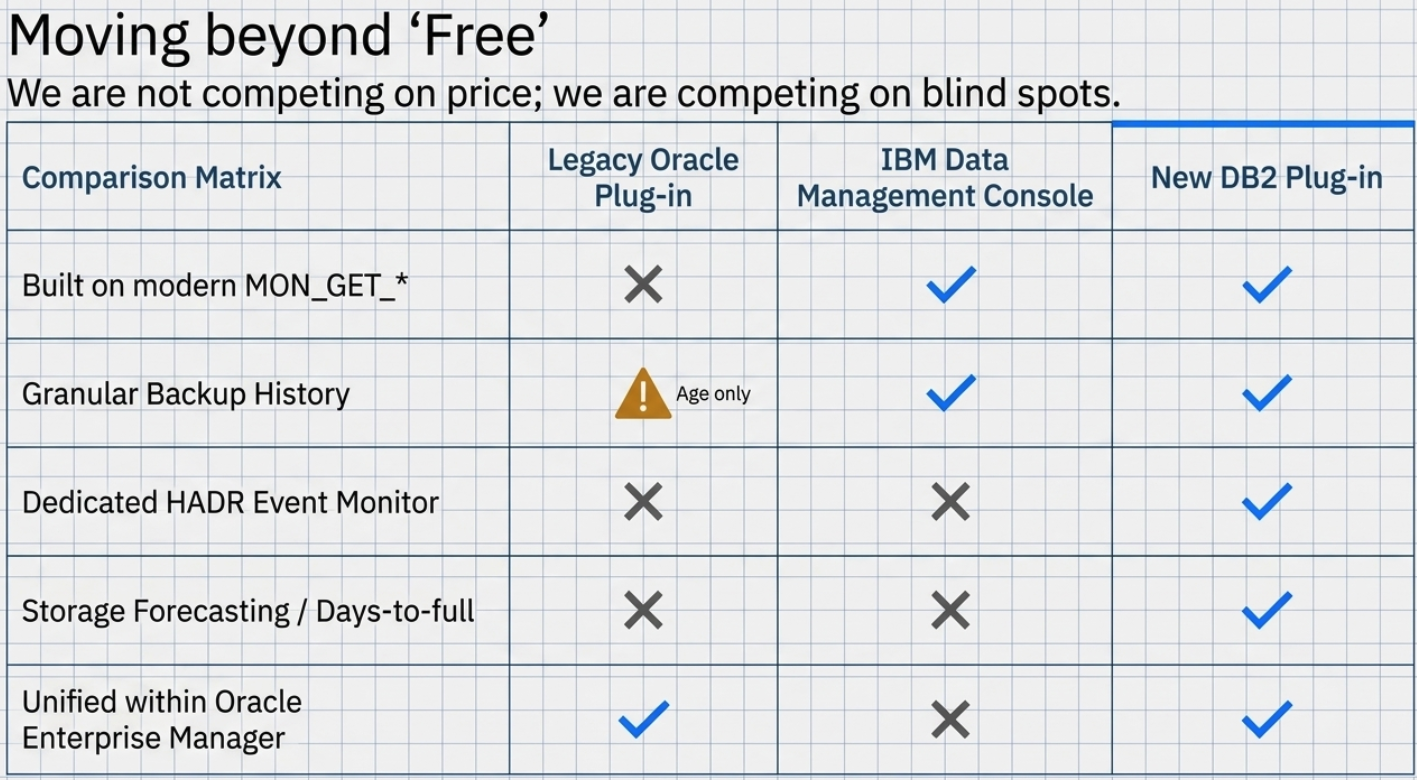
IBM ships a free console, Data Management Console, and it's good at what it does. We're not here to compete on price with a free tool. We're here for the things it doesn't do, and for teams who'd rather see DB2 in the same Oracle Enterprise Manager estate they already run everything else from.
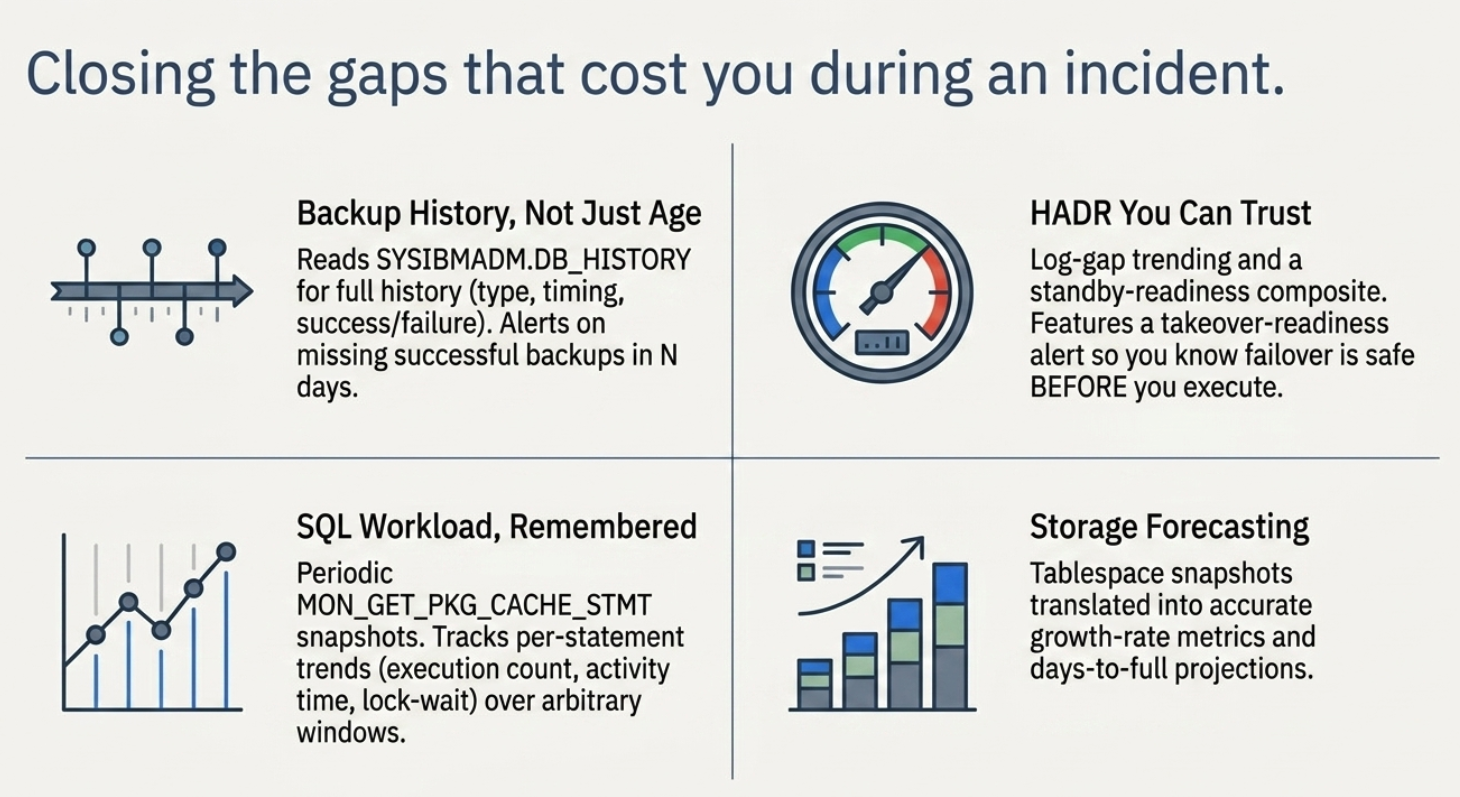
The July release closes the gaps that actually cost you during an incident:
- Backup history, not just backup age. The plug-in reads
SYSIBMADM.DB_HISTORYfor full backup, restore, and load history, including operation type, timing, and success or failure, and alerts on a failed backup, restore, or load immediately, with backup age carrying shipped thresholds of its own: a warning once a database passes a day without a successful backup, a critical past three. That's a step past the age-only metric the old Oracle plug-in offered, and it reads under a least-privilege grant over a standard database connection. - HADR you can trust during a failover. This is the one that matters most, and it's where IBM's own free console stops short: DMC doesn't offer an HADR event monitor. The plug-in adds log-gap trending and a standby-readiness composite with a takeover-readiness alert, so "is my standby actually ready to take over?" is a number you watch rather than a question you ask after the fact.
- Your SQL workload, remembered. Periodic snapshots of the package cache (
MON_GET_PKG_CACHE_STMT) into the repository give you per-statement trends over arbitrary windows: execution count, activity time, lock-wait, rows read. That replaces the point-in-time top-N the old plug-in showed. July tracks the numbers; capturing the full statement text and explain detail comes in a later wave, on purpose. - Storage you can forecast. Tablespace snapshots become growth-rate metrics and days-to-full projections, forecasting IBM's free console doesn't provide.
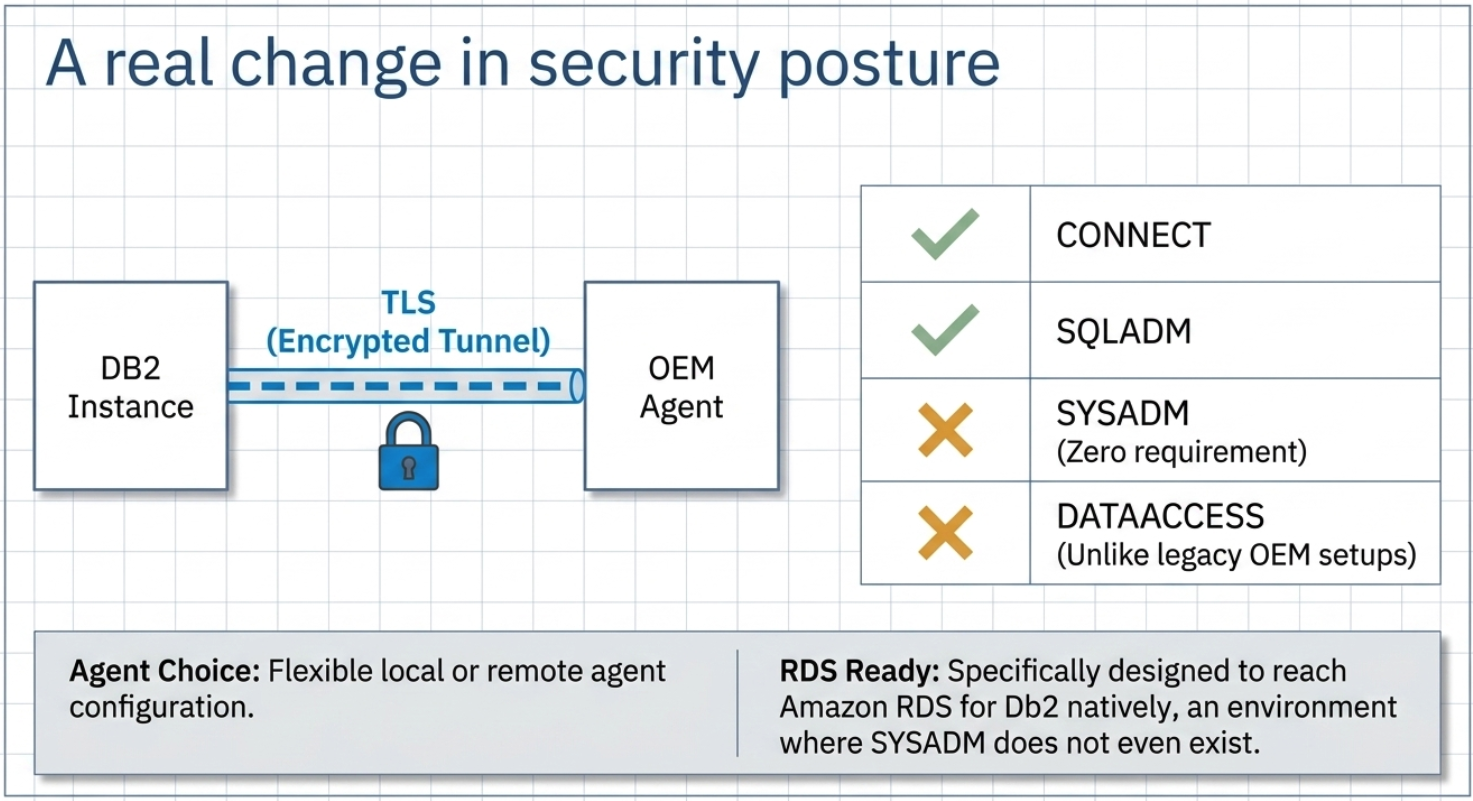
- Sensible defaults and least-privilege from day one. Twenty-three curated WARNING and CRITICAL thresholds ship already set, and the whole thing runs from a
CONNECT + SQLADMgrant over TLS, with noSYSADMand your choice of a local or remote agent. That's a real change in posture: the stock Oracle plug-in's own setup leans on the older snapshot interface and a broaderDATAACCESSgrant. The same connection model is designed to reach RDS for Db2, whereSYSADMdoesn't even exist as something you can hold.
None of that is exotic. It's the difference between a console that shows you DB2 is up and a console that tells you whether it's safe.
3. The new ground we're building toward
Here's where DB2 gets genuinely interesting, and where I want to be careful about tense. The two capabilities below are on the roadmap, not in the July release. They're the reason DB2 is the most exciting of the three plug-ins to work on, but they're coming, not shipped.
- Db2 for z/OS, a first for Oracle Enterprise Manager. No Oracle EM plug-in has ever monitored Db2 for z/OS. A defined subset is reachable over pure JDBC:
ADMIN_COMMAND_DB2runs Db2 commands like-DISPLAYthrough a SQL call and hands back their output, and the real-time statistics catalog tables are queryable with ordinarySELECTs. The honest boundary matters here. Per-transaction accounting stays with the IFI and SMF tools built for it, like OMEGAMON. We're positioning z/OS coverage as health, objects, and advisories, complementary to those tools rather than a replacement for them. - AI Query Optimizer monitoring. Db2 12.1 introduced an AI Query Optimizer that uses machine learning to sharpen the optimizer's cardinality estimates. It's a genuinely new surface that monitoring tools are only starting to expose. Surfacing its model inventory and the optimizer's AI-driven decisions is on the roadmap, because it's a capability that didn't exist to monitor until now.
Both are sequenced after the July core for a reason: the foundation ships first, the frontier follows. But they're the direction, and they're why the DB2 plug-in's ceiling is higher than a parity rebuild.
DB2 isn't facing a reckoning this summer, and that's exactly why it's easy to leave the monitoring where it's been for years. The case here isn't panic. It's that a database you're going to run for a long time deserves to be seen properly: backup history you can audit, HADR you can trust under failover, SQL workload you can look back on, storage you can forecast. And, on the way, ground no one else has covered.
This is the fifth post in a series on the blind spots your estate monitoring leaves across MySQL, SQL Server, and DB2. The earlier four were The Backup You Can't See, on whether last night's backup actually succeeded; The DR-Readiness Gap, on whether a "synchronized" cluster could really fail over without losing data; SQL Server 2016 End of Support, on the July 14 version cliff; and After MEM: The Next Chapter for MySQL Monitoring in Oracle Enterprise Manager, on continuity for MySQL monitoring after MEM and the EM plug-in's deprecation. This one is the odd member of the set, because DB2's date is the only one still ahead of you.
Get Early Access
Backup history, HADR depth, SQL workload history, forecasting, curated thresholds, and a least-privilege, TLS-first connection arrive with the DB2 Plug-in for Oracle Enterprise Manager, and Early Access opens July 31, 2026. The z/OS and AI Query Optimizer coverage is on the roadmap beyond it. Learn more and sign up:
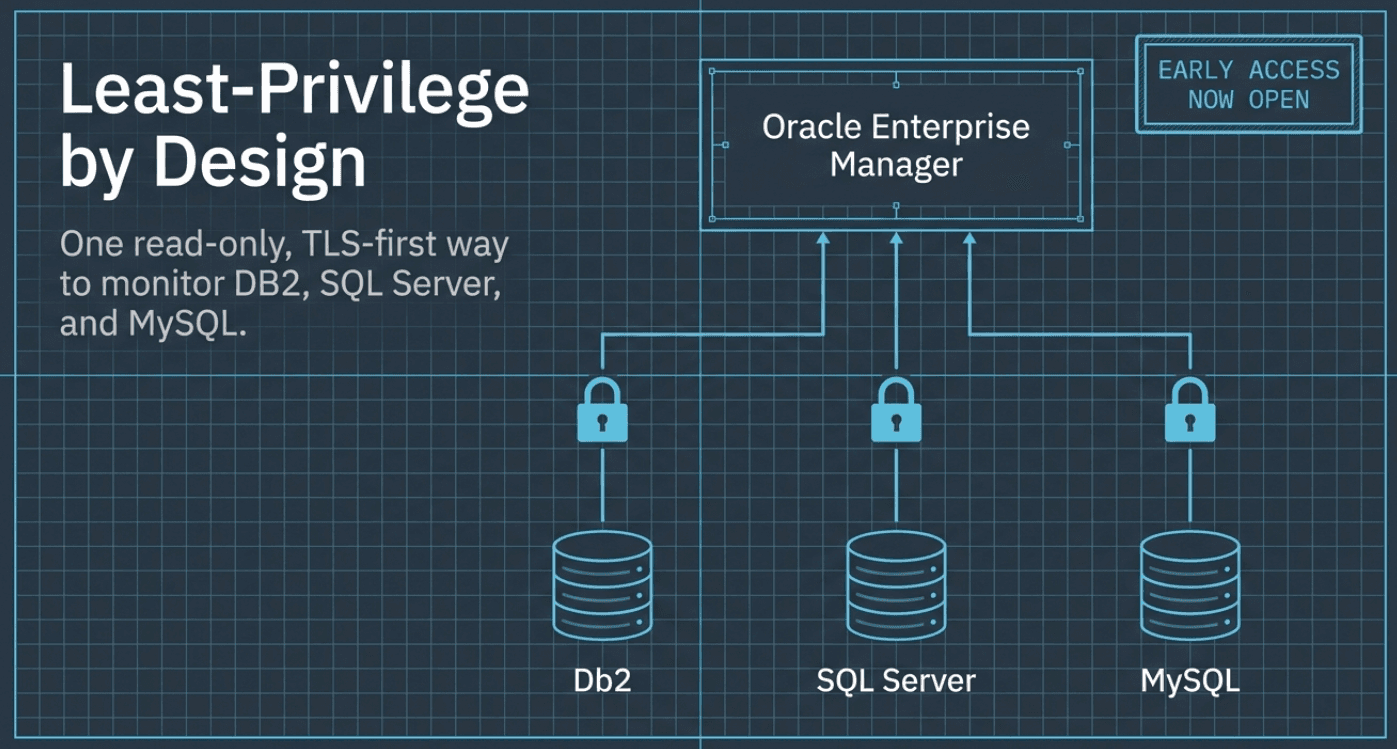
The same least-privilege, TLS-first approach runs under the MySQL and Microsoft SQL Server plug-ins, too.
Next in the series, least-privilege by design: one read-only, TLS-first approach to monitoring DB2, SQL Server, and MySQL, on-prem and in the cloud.
Is there a DB2 end-of-support deadline I should be worried about this year?+
Not this year, but 11.5 has one: IBM supports Db2 LUW 11.5 until April 30, 2027. There's no published end-of-support date for 12.1 at all, which is what makes it the destination rather than another waypoint. Two dates are already behind you — 11.1's extended support ended on April 30, 2026, and Db2 Base Edition 11.5.x left standard support on September 30, 2025 — so an instance on either is genuinely stranded today. The plug-in's compliance rule is built for exactly this: it compares each target's release against IBM's published dates and raises a critical violation once one has passed, which means your 11.5 estate begins flagging itself on May 1, 2027 with no plug-in change and nothing for anyone to remember.
Which DB2 versions does the plug-in monitor?+
Db2 LUW 11.5 and 12.1, with version gates carried forward in the collection layer rather than bolted on. Both releases expose the modern MON_GET_* table functions, which is what the plug-in collects through, so the same collection works across both without a separate code path for each.
IBM's Data Management Console is free. Why would I pay for this?+
For the things DMC doesn't do, and for where you want to see them. DMC has no HADR event monitor and no storage forecasting, which are two of the questions that matter most during an incident and during capacity planning. And if your team already runs Oracle Enterprise Manager for the rest of the estate, this puts DB2 in the same console rather than in a second one. We're not trying to beat a free tool on price.
What privileges does the plug-in need on each database?+
A CONNECT plus SQLADM grant, over TLS. No SYSADM, no operating-system access, and your choice of a local or remote agent. That's a deliberate change from the stock Oracle plug-in's setup, which leans on the older snapshot interface and a broader DATAACCESS grant. The same model is designed to reach RDS for Db2, where SYSADM doesn't exist as something a customer can hold.
Does it monitor Db2 for z/OS?+
Not in the July release. z/OS coverage is on the roadmap, and it would be the first Oracle EM plug-in to monitor Db2 for z/OS at all. The approach is pure JDBC: ADMIN_COMMAND_DB2 runs Db2 commands such as -DISPLAY through a SQL call and returns their output, and the real-time statistics catalog tables can be read with ordinary SELECTs. The boundary is deliberate. Per-transaction accounting stays with the IFI and SMF tools built for it, like OMEGAMON, and our coverage is scoped to health, objects, and advisories alongside them.
What about monitoring the AI Query Optimizer in Db2 12.1?+
Also roadmap, not July. Db2 12.1 introduced an AI Query Optimizer that applies machine learning to the optimizer's cardinality estimates, and it's new enough that monitoring tools are only beginning to expose it. Surfacing the model inventory and the optimizer's AI-driven decisions is planned, sequenced after the core release ships.